
Learning to cross the street: Exploring immigrant integration
While this blog is generally reserved for short, sweet updates and news related to Renew Northwest, we may occasionally try something longer-form, sharing personal experiences intended to spur deeper reflection and discussion. This piece was written by Renew’s Director, Steven, who spent the years 2008-2014 living and teaching in Southeast Asia.
First, a vignette
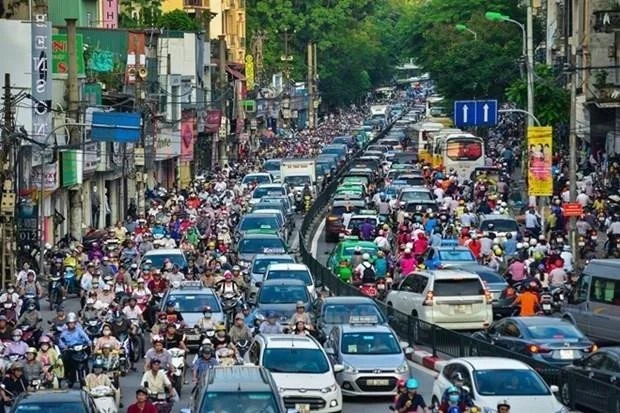
Typical Vietnam street scene. Really.
I am standing at an intersection of two impossibly busy streets in Hanoi, Vietnam. It is February 2008. I am jet-lagged but excited, both curious and utterly bewildered. I’ve been in Vietnam for all of 24 hours and nothing makes sense.
My main goal for the day is to cross the street to the DaeWoo Hotel which lies opposite the apartment my wife and I have landed in, in order to see what kind of Western food their small convenience store sells. I’m not sure I’m up to the task.
The hotel and its tantalizing collection of imported food is all of 75 yards away, but it lies on the other side of an ever-flowing stream of Honda Dream and Vespa motorbikes, green Mai Linh taxis, giant, diesel-belching dump trucks and city buses whose drivers seem intent on committing vehicular homicide. Everyone is honking their horns simultaneously.
Kitty-corner from me at the same intersection is—I kid you not—a high school football-style scoreboard showing the number of traffic fatalities the city has suffered over the day and the past year. I assume it is an undercount by at least an order of magnitude.
I cannot even cross the street, I think to myself. What on earth have I gotten myself into?
Such was my experience at the start of over six years spent living and teaching in Vietnam. Anyone who has traveled in Southeast Asia will vouch for its veracity. Newly-arrived Westerners accustomed to stoplights, walk signals and glowing orange “do not cross” hands with a helpful second-by-second countdown are universally in awe of the apparent impossibility of not dying while crossing the street in a city of any size.
And yet, the attempt must be made. If you’re wise, the first time you try, you’ll wait until a local begins to cross and then scramble frantically to walk in parallel with them, holding your breath and essentially using them as a human shield against the crush of oncoming vehicles. Here goes nothing.
An old complaint
We’ll get back to that Vietnam street scene soon enough, but first a diversion into the current rhetoric around American immigration policy (which, as it turns out, isn’t so current after all).
A word that comes up often in conversations about immigration is “assimilate,” and its much clunkier relative “unassimilable.” The charge is made—generally by those in power or the media—that immigrants (especially when they arrive in large numbers, whatever that might mean) often fail to assimilate to American culture. Take this exchange between Stephen Miller, the man at the center of this administration’s immigration policy, and a Fox News host as a representative example.


A representative political cartoon from the 1920s showing all of the “unassimilated aliens” arriving via a “flood of immigration” from Europe and Asia.
Note a few things here:
It is assumed as a fact that immigrants don’t assimilate. No evidence is given, no statistics are examined. Just a straight-up claim that “everyone knows immigrants don’t assimilate.”
The ideal timeframe and specifics of what would constitute “acceptable assimilation” is never clearly defined, which allows it to reside in the collective consciousness as a fuzzy gut feeling rather than a hard fact. Anything from vague rumors of Sharia law being implemented in various parts of America (Dearborn, Michigan maybe? Who knows?) to people speaking Spanish with their families in the neighborhood park can be taken by Americans as further confirmation of immigrants’ unwillingness to assimilate.
Complaints about this unwillingness to assimilate to American culture stretch back to, well, before the founding of the United States. In different eras, these accusations have been leveled at immigrant populations from Germany, Italy, Ireland, Sweden, China, Japan… With sinister effect, the label of “unassimilable” has been placed on Jewish populations around the world for centuries.
Having just emerged from the holiday season, I was struck this year by the way that the concept of ethnicity and assimilation is highlighted in a 1940s classic like It’s a Wonderful Life. In one compelling scene, the scheming, exploitative Mr. Potter berates the film’s protagonist, George Bailey, for “frittering his life away playing nursemaid to a bunch of garlic eaters.” Bailey’s sin, in the mind of Mr. Potter, was that he was wasting his time and talent providing affordable housing, dignity and economic opportunity to first-generation Italian immigrants. Indeed, there is nothing new under the sun.

It’s wild how fast that goal can move
The concept of assimilation very often devolves into a classic case of moving goalposts. Did <<insert newly-arrived immigrant group here>> go and learn English and find entry-level work for themselves? Well, good for them but they are still a drain on our social welfare programs. Oh, did they achieve upward mobility and begin starting their own businesses and providing for their families without government support? Well, they are still an insular group that only cares about themselves and not the wider society. Oh, did their kids pursue higher education and start entering positions of influence and power? Well, now they are trying to foist their values and beliefs on the rest of us…see how easy this is?
At each point along this trajectory—which for ages has been labeled by most folks as “The American Dream”—gatekeepers in the majority culture are quick to play the “assimilation” card in order to discredit, minimize, invalidate or cast as suspicious the steps that immigrants and their children have made toward success.
Perhaps, then, assimilation isn’t the goal that it’s cracked up to be. What, I wonder, would be a better goal?
Getting back to that street scene in Vietnam…
So, what actually happens when you finally gin up the courage to step out into traffic on a busy Vietnam street? Something barely short of miraculous: The unbroken stream of traffic simply splits, as though you possessed some sort of magical force field that compels the drivers to give way. With your heart in your throat, you walk steadily across the street and the miracle continues. Motorbikes—even cars—work their way around you without skipping a beat. People adjust to your presence. You survive and reach your destination. They survive and reach theirs. It works.
I lived for over 6 years in Vietnam. I crossed many busy streets during that time. I’m pleased to report that I am still alive today.
The act of crossing the street in Vietnam is, for me, a metaphor that we can apply to our views of immigration. It is a picture, not of assimilation but of integration. What is the difference between these two related-but-different concepts?
Assimilation vs. Integration
An assimilation model implies that the burden is on immigrants living in America to remake themselves into something different, in order to “fit in” to our society. This is the classic melting pot vision, in which an arriving immigrant gets subsumed into the greater recipe they’ve become a part of. Whatever they brought with them that was unique needs to disappear or at least become greatly diluted in the rest of the soup.
Integration, on the other hand, implies that both parties—the immigrant and the host culture—will be influenced and changed by the other. There is a reciprocal, relational, trust-based element to integration that is lacking in assimilation.
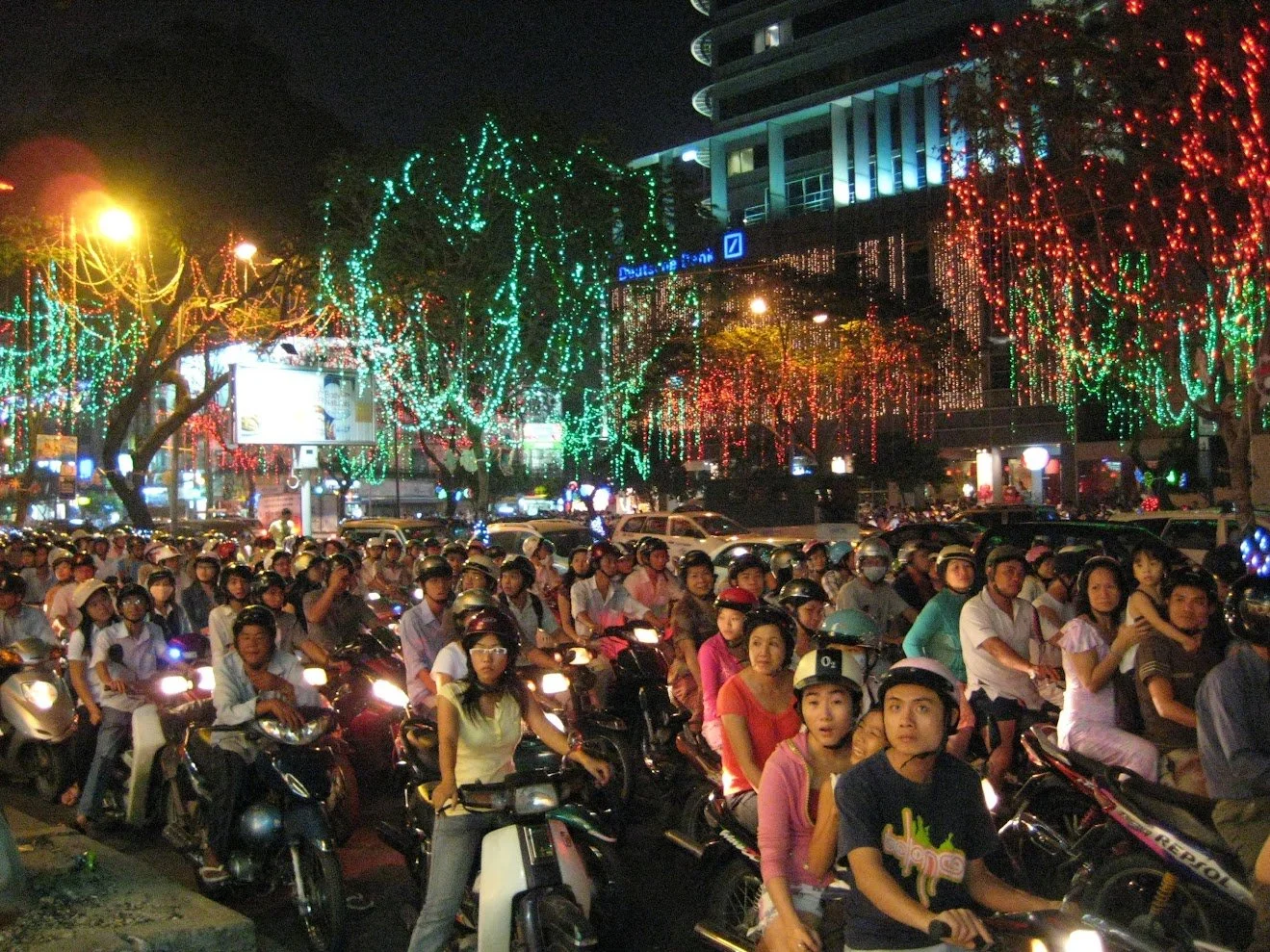
They’ll let you through, I promise
As you step out onto that crowded Hanoi street, the motorbikes shift their course slightly to give you space. Of course, this doesn’t mean that a pedestrian should sprint heedlessly into traffic, or stop cold in the middle of an intersection to take a selfie—both of those would be exceedingly unwise in a Vietnamese context.
There are significant constraints to how one behaves in a Vietnamese street, and you ignore them at your own peril. However, here are a few things you won’t see happening.
A motorbike driver won’t berate a pedestrian just for walking, or vice versa.
People who drive cars don’t huddle together on podcasts and scheme how they can rid their streets of pedestrians, for the crime of not being drivers.
Very different types of people can exist in the same space if each is willing to adjust their trajectory slightly.
In the same way, integration does require change from both parties. An unwillingness to adjust to the reality of the other party—whether pedestrian or driver, immigrant or host culture—will result in collision and injury.
Webster’s dictionary definition of the verb integrate is “to form, coordinate, or blend into a functioning or unified whole.” The root Latin word “integer” has at its core the concept of completeness. Two or more separate entities become united into one. Isn’t this one of those values that we claim to hold dear in these United States of America?
To me and many others, the goal of integration is a much more helpful, hopeful and much more truly American vision than the assimilation “lose-yourself-in-the-collective” approach. Does this mean that immigrants should ignore American laws, norms and cultural values? Of course not. And here is the thing: The vast majority of immigrants both want and need to integrate in order to thrive here. They and their children want to and do learn English (though that can be a challenge when you’re working 60 hours a week to support your family). They want to and do learn about American laws, education, health care, employment… And at the same time, our culture is impacted and influenced in beautiful ways by the presence of newcomers in our communities. It works.

There is much more that can be said on this topic, and perhaps we’ll explore it in more depth in future entries. I leave you with one suggestion for further study: The well-researched and thoroughly documented 2019 book America for Americans: A History of Xenophobia in the United States by Erika Lee is a sobering historical account that is absolutely worth a read. She explores in much greater detail than I can here the repeated waves of xenophobia that have been a part of our culture not for years or decades, but centuries. Often, this xenophobia is marched out under the guise of appeals for greater assimilation. Here’s the link to Whatcom County Library’s copies, or grab it from your favorite retailer.
